LIVE IN BRUSSELS AND ONLINE 10 & 11 March 2027


Signed in as:
filler@godaddy.com
The purpose of this conference, which I had the pleasure of chairing, was to understand how ETCS/ERTMS is actually being delivered at scale — and how it can be treated as a transformation without destabilising operations, budgets, authorisation processes, rolling stock economics, or workforce capability.
Most people reading this will already recognise that ETCS and ERTMS implementation is not simply a signalling project. It’s a system-wide change.
And in truth, the technology itself wasn’t really being questioned.
The case studies demonstrated that it can be made to work operationally.
What the discussion kept coming back to was something more commercial and practical.
Whether it can be delivered consistently, affordably, and repeatedly, across different parts of the railway — particularly for regional and freight operations — without becoming progressively more complex and costly each time.
Across the two days, the presentations covered a wide range — from national programmes through to specific corridor delivery and supplier perspectives.
But once you moved into the Q&A and the conversations around the sessions, the themes became quite consistent.
The point that came up repeatedly was that:
Authorisation, testing and assurance are central to the delivery challenge.
As something that directly affects:
At the same time, no one was suggesting these processes can simply be reduced. Safety remains the overriding requirement.
The difficulty is that the current framework is not easily repeatable at scale, particularly when applied across different fleets, countries and operational contexts.

Observation: delivery is shaped more by constraints than by design intent.
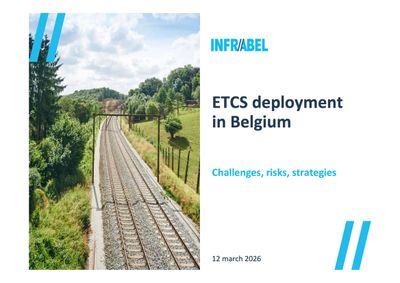
Bavo brought a detailed, experience-led perspective, based on over a decade working directly on ETCS programmes.
The Belgian programme was framed clearly as a safety-led transformation, rather than a purely operational upgrade — a point reinforced by reference to various accidents across Europe.
Approach and Trade-offs
What stood out was not just the scale of the programme, but the choices made in how to approach it.
These included:
None of these are straightforward decisions, and each carries trade-offs. What was useful was understanding the reasoning behind them, rather than just the outcomes.
Working Within Constraints
The reality described was a brownfield environment, with all the associated limitations:
Sequencing and Risk
There was also a clear emphasis on sequencing:
Again, not as abstract strategy, but as a way of managing operational risk.
Human Factors
As in earlier discussions (including London 2025), human factors were brought in early:
What was helpful here was the explanation of why these decisions were taken when they were, and how that thinking developed over time.
Observation: planning discipline becomes more important as uncertainty increases.
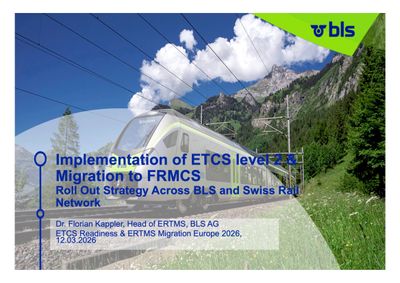
Dr Florian Kappler (BLS AG) described the challenge of migrating a live, mixed-use network.
To put that in context:
ETCS was presented not in isolation, but as part of a wider system including:
Some of these elements are still evolving, which introduces uncertainty into planning.
Rather than fixing a single path early, different scenarios were tested:
These were then narrowed into a preferred approach, balancing cost, risk and impact.
A point that came through clearly — both in the presentation and discussion — was the need to align:
Early in the process.
This is straightforward in principle, but more difficult in practice when not all end states are defined.
There was also a more reflective point around cost.
Short- to medium-term optimisation is relatively manageable.
The more difficult challenge is ensuring that decisions taken now do not lead to repeated upgrades or rework later.
Where that longer-term view is not built in, cost tends to reappear over time.
Observation: cost is driven more by lifecycle behaviour than initial installation.
Etienne Kuntzel outlined the scale of rollout required across Europe — tens of thousands of vehicles over the coming years.
At current delivery rates and cost structures, there is a clear gap between ambition and execution.
Where Cost Accumulates
A key point made here, and reinforced elsewhere, is that cost is not concentrated in installation.
It accumulates over time through:
Role of Architecture
Part of this comes back to how systems are designed.
Where architectures are tightly coupled or bespoke:
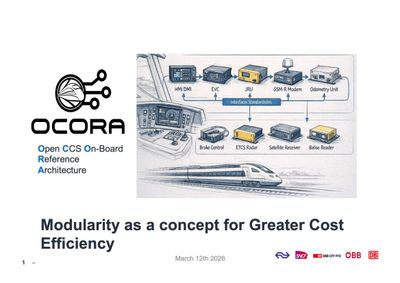
Modularity as an Ongoing Direction
The move toward more modular architectures is therefore seen less as optimisation, and more as a way of managing future complexity.
In practice, that means:
The discussion acknowledged that this is not simple to implement, particularly given existing systems, but the direction of travel was clear.
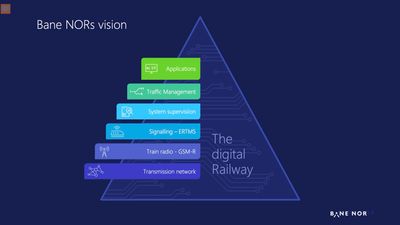
Kjell Holter of Bane NOR presentation related to a living example of the digital railway in operation.
The approach integrates ETCS within a broader digital architecture, combining signalling, traffic management, and communications systems. Strong emphasis is placed on system and operational standardisation, replacing fragmented legacy systems with unified functionality.
Pilot and early deployment lines demonstrate high safety, availability, and low maintenance, supporting the case for ETCS Level 2 without signals. However, technical challenges remain, particularly in odometry, where GNSS and radar solutions each have limitations.
The programme also looks ahead to future capabilities, including ATO, FRMCS, and train integrity.
Overall, Norway’s experience shows that ETCS can be successfully deployed at scale, but requires strong integration, standardisation, and ongoing technical adaptation.
Thomas walked through the ETCS migration on the Nice–Ventimiglia corridor — a relatively short but complex coastal line in the south of France — which has been used as a pilot for a number of reasons.
It’s geographically constrained, has a relatively contained fleet, and the signalling assets were reaching end of life, dating back to electrification in the late 1960s. So it presented a combination of pressure points that made a viable test case.
What was particularly valuable about this session is that it didn’t spend much time on the standard ETCS talking points.
Issues like:
were acknowledged, but not treated as the main story.
Instead, the focus shifted to the areas that tend to have a more direct impact on delivery — and, importantly, on cost.
In particular:
Brownfield Reality, Properly Understood
There was also a more implicit point running through the presentation.
This is not a greenfield deployment where you can optimise the system from the outset.
It is a live, ageing railway, where:
A few of the more practical aspects were worth noting.
One was the impact on station design and operational precision, particularly where capacity gains are expected. These are not marginal adjustments — they require a level of alignment between infrastructure and operations that is quite demanding.
Another was the continuous renewal requirement. On a line of this age, ETCS is not being introduced in isolation — it sits alongside ongoing work just to maintain the baseline level of safety and performance.
And then there is the issue of overlapping projects. Managing ETCS alongside other major works on the same corridor creates sequencing challenges that are not easy to resolve.
Thijs van Steen, Programme Director for ERTMS in the Netherlands, emphasised that:
ERTMS is not just an infrastructure programme.
It is the coordination of an entire ecosystem:
— all under conditions of uncertainty.
Governance Model
What stood out was the governance approach:
Not:
And not:
But a structured, multi-layer model, involving:
How Decisions Are Made
Decision-making is:
With clear principles for:
One of the most striking insights:
“Culture eats strategy for breakfast.”
The implication being:
Success depends less on technical execution, and more on:
This session moved away from general discussion and into a very specific operational case — retrofitting a freight fleet under current regulatory and technical conditions.
The Linéas example provided that anchor (Linéas co-authored the presentation but were unable to make the event in person)
A fleet of just over 100 locomotives, operating across multiple countries, with a long maintenance horizon and no real option to step out of service for extended periods. In that sense, it reflects the reality many freight operators are dealing with.
One point that came through clearly is that, taken step by step, the retrofit process itself is not especially complicated.
It follows a familiar structure:
In isolation, none of these stages are new.
Where it becomes difficult is how that process behaves at scale and over time.
What was especially interesting — and where this session added something different — was in how the signalling company framed a way forward.
The core idea was a shift away from a hardware-led, reauthorisation-heavy model, toward something more software-driven and upgradeable.
In practical terms, that means:
The argument wasn’t that authorisation disappears — clearly it doesn’t — but that the frequency and scale of intervention can be reduced if the system is designed differently from the outset.
For freight operators, the current model tends to treat each upgrade or change as a significant event:
Which leads to repeated cost and downtime.
The alternative being suggested is a model where:
That doesn’t remove the underlying complexity, but it does change how often it has to be dealt with in a disruptive way.
So the signalling company’s approach is essentially trying to flatten that curve — not just by simplifying the initial retrofit, but by reducing what happens afterwards.
This session provided a useful shift in perspective, moving away from infrastructure and system design, and focusing on what is often treated as a secondary consideration — how drivers and the supporting operational workforce actually adapt to ETCS in practice.
Rafal approached this less as a training topic and more as a transition in how the railway is operated at a human level.
The central point he made — and it’s one that is easy to underestimate — is that ETCS does not just introduce a new interface.
It changes the role of the driver.
Moving from:
to:
It is a shift in how decisions are made, how attention is managed, and how confidence in the system is built.
The cost of training came through quite clearly.
Training a single driver can exceed £100,000, depending on the approach taken and the level of simulation involved.
But the more important point was not the headline figure — it was what drives that cost.
In particular:
If those are not managed well, the cost increases quickly, and the impact is not just financial — it affects operational readiness.
Simulation as Part of the Programme, Not an Add-On
What SimFactor is proposing is to treat simulation differently.
Not just as a training tool, but as something that supports the wider programme.
In practice, that means using simulation earlier and more continuously:
There was also a useful distinction made between different types of simulation.
Not everything needs to be a full cab environment.
Depending on the stage, different tools can be used:
This is partly a cost consideration, but also about using the right level of fidelity at the right time.

It is how Europe can:
Treat ETCS rollout as a learning system,
not just a delivery programme